The AI race is usually told through chips, models and stock-market valuations. But a quieter contest is unfolding around something far less glamorous: access to electricity.
On 16 November 2026, the Financial Times reported that Germany's state-owned energy group Uniper was approaching a first agreement to sell or lease a former power-station site for data-centre development. The company is also in advanced discussions about two other sites, according to the report. These are talks, not completed conversions.
The appeal is simple. A site that once hosted large-scale power generation may already have the land, industrial access and — most importantly — a valuable connection to the electricity grid.
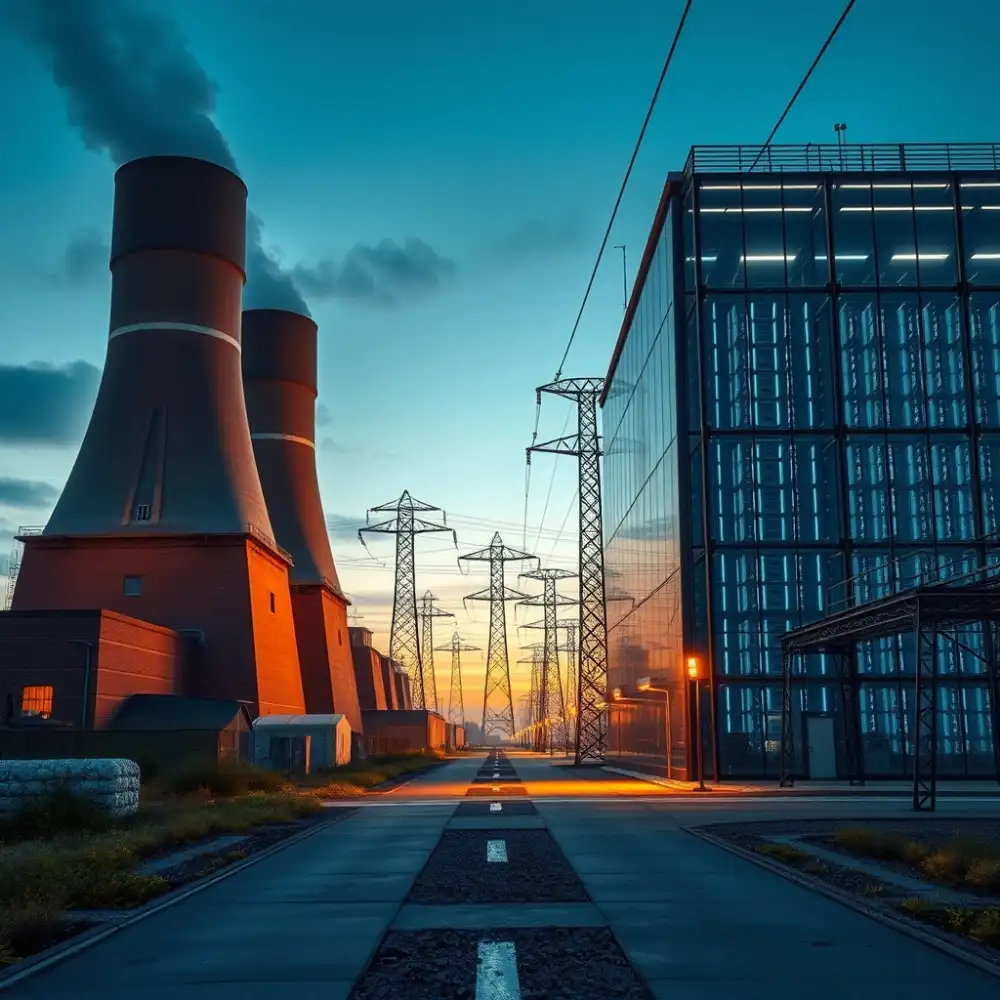
Illustration: AI-generated concept art showing a former industrial power site alongside a modern data centre. It is not a photograph of any Uniper facility.
Why the grid connection matters more than the building
Imagine trying to build an AI data centre from scratch. Buying land and constructing a server hall are only part of the job. The operator also needs reliable electricity, cooling, fibre connections, permits and the ability to expand.
A large data centre may require tens or hundreds of megawatts. Obtaining that power is not as simple as plugging into the nearest transmission line. New substations, transformers, transmission upgrades and approvals can introduce years of uncertainty.
This makes existing industrial sites unusually interesting. A retired power station does not automatically become a functioning data centre, and its grid rights may need modification. But its previous connection can give a developer a head start compared with a remote greenfield project.
Uniper says it is exploring opportunities to attract data centres to its power-plant sites. Its November 2026 quarterly statement explicitly describes this as part of its strategy for new revenue.
What Uniper is actually proposing
According to the Financial Times report published on 16 November, Uniper has identified ten potential sites across Germany, the United Kingdom, Sweden and the Netherlands. Together, they have roughly 700 megawatts of secured grid capacity, with possible room for more.
That is an infrastructure opportunity, not evidence that 700 MW of AI computing is already running. Nor is it a guarantee that every proposed site will become commercially viable.
Developers still need to solve practical problems: suitable cooling, reliable network connectivity, local planning permission, environmental obligations, electricity pricing and the cost of repurposing old land.
The distinction matters because excitement about AI can turn an early-stage property proposal into a headline that sounds like a completed deal.
The scale of the electricity challenge
The International Energy Agency's updated Key Questions on Energy and AI analysis projects that global data-centre electricity demand could rise from approximately 485 terawatt-hours in 2025 to 950 TWh in 2030 in its central scenario.
A terawatt-hour measures energy consumed over time. A megawatt measures the instantaneous rate of electricity use. So Uniper's 700 MW of reported grid capacity cannot be directly compared with the IEA's 950 TWh annual forecast without assumptions about utilisation and duration.
This is precisely why serious discussions need both numbers. AI's expansion is constrained not only by the quantity of power available worldwide, but by whether the right electricity can be delivered at the right place, reliably, at an acceptable price.
The IEA also warns that electricity equipment and grid bottlenecks can delay projects even when enthusiasm for building data centres remains high.
Where geopolitics enters the story
The energy–AI connection reaches beyond local planning decisions.
Europe is trying to balance energy security, industrial competitiveness and decarbonisation. AI data centres put pressure on all three. Governments want investment and digital infrastructure, but adding large electricity consumers can raise difficult questions about grid priority, energy costs and emissions.
Supply chains complicate the picture further. Transformers, power electronics, batteries and other essential equipment may depend on internationally concentrated manufacturing. The IEA's research highlights how some critical inputs are concentrated in a small number of producer countries, including China.
This means debates about semiconductor exports and technology sovereignty are only one part of the AI geopolitical story. Access to reliable power infrastructure and its equipment can matter just as much.
What investors should—and shouldn't—read into it
There is a reason utilities, grid operators, electrical-equipment manufacturers and industrial-property owners have attracted attention in discussions about the AI boom. Data centres could create new customers and increase the strategic value of existing assets.
Yet an asset that is desirable to an AI developer is not automatically a profitable investment.
A site might demand expensive remediation. Grid rights might be difficult to transfer. Revenues depend on the actual contract, infrastructure commitments, electricity prices and how much capital must be spent before any rent or service income arrives.
Uniper's situation has another complication: it is state-owned, and a possible future sale or listing is a separate political and financial question. Readers should not mistake media reports about its data-centre ambitions for a stock recommendation, a confirmed transaction or proof of valuation.
The useful questions are concrete: Who is paying for the upgrade? How much capacity is contractually available? When can a tenant connect? And what is the expected return after the costs?
The bigger lesson
AI competition is increasingly a physical infrastructure race. Better models still need chips, but those chips need power, buildings, cooling and enormous quantities of electrical equipment.
Uniper's reported negotiations illustrate how an old industrial site can gain new relevance in a digital economy. They also show why the next valuable AI asset may be something familiar, unglamorous and already connected to the grid.
The story is not that old power stations have become AI centres overnight. It is that the infrastructure they leave behind may be worth examining before anyone builds from scratch.
Sources
- Financial Times, 16 November 2026 — Uniper nears first deal to repurpose power-plant sites
- Uniper, 10 November 2026 — Q3 2026 quarterly statement
- International Energy Agency — Key Questions on Energy and AI, executive summary
Analysis and reporting context checked on 16 November 2026. This article is for general information, not personalised investment advice.